Mold Removal in Coppell, TX
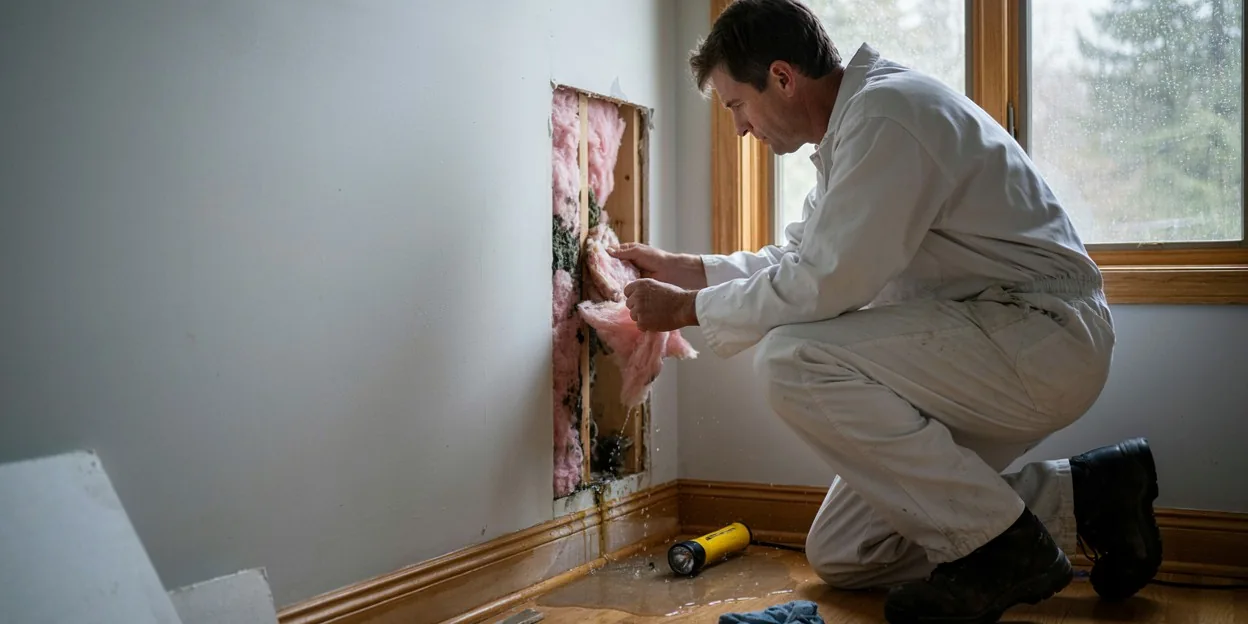
Coppell sits directly north of Irving's Valley Ranch, tucked between Denton Creek, Grapevine Creek, and the north edge of DFW Airport. It stayed a farm town until the airport opened in 1974, then built out almost entirely in the 1980s and 1990s, so the housing is unusually uniform: two-story brick houses on post-tension slabs, air handlers in the attic, PVC drains, and a master bath with a garden tub and a separate shower.
That uniformity means Coppell mold calls repeat. The attic unit's condensate line clogs in August and the pan overflows into a hallway ceiling. A shower pan cracks after twenty-five years and wets the wall between the master bath and a closet. A supply line in the attic split during the February 2021 freeze, was patched in a hurry, and the insulation under the patch never dried.
A Coppell homeowner who calls this number is routed to one independent local provider who handles mold removal and remediation here. That company reads the house with a meter and writes the scope; the agreement is between you and them.
Coppell mold removal behind a 1992 master bath and under a 2021 ceiling patch
Growth behind a vanity or under a cracked shower pan is bathroom mold removal. Streaked roof decking and damp insulation under a freeze-split line is attic mold remediation. A hallway ceiling under an overflowing pan is HVAC mold cleaning.
Old Town and the permit office next to it
Coppell's rebuilt Old Town district along Bethel Road is a short walk from the City of Coppell offices, where any rebuild that touches plumbing or electrical gets its permit. The provider handles that step; you handle the paint color.
Call (469) 652-8352 and describe the ceiling, the wall, or the smell. We put you through to an independent local mold provider serving Coppell.
Services Available in Coppell
Mold Removal
Growth on drywall after a slab leak, a water heater, or a washer line: room sealed, wet board cut to the meter mark, framing HEPA-cleaned and dried.
Black Mold Removal
A dark patch handled by how far the water traveled, not by its color: containment, porous material out, hard surfaces cleaned, leak fixed first.
Whole-Home Mold Remediation
A slab leak or a burst pipe that ran through several rooms, mapped wall by wall and cleared in zones as one planned project.
HVAC Mold Cleaning
Coil, drain pan, and condensate line cleaned or replaced when the attic air handler sweats through a 100-degree August.
Bathroom Mold Removal
Growth behind a vanity, under a shower pan, or on a ceiling with no fan, removed after the supply or drain leak is fixed.
Attic Mold Remediation
Growth on roof decking under hail-cracked shingles or around a sweating duct, cleaned and treated once the roof and insulation are handled.
Mold Odor Removal
A musty smell in a house that looks fine, traced to the wet pad under the floor or the cabinet back, then removed and treated.
Mold Damage Repair
Drywall, texture, baseboard, and cabinet bottoms put back after removal, once the slab reads dry and the leak is repaired.